
A Widow's Journey
Anna Jacintha decides to leave the Azores for Hawaii

Anna Jacintha (de Mello) Pacheco was living alone with 6 of her 7 children in the village of Achada in the Azores in 1882. My great great grandmother called herself a widow, but was she a widow because her husband died or because he disappeared? No matter. He was gone.
What were the options for a woman in a small village with hungry children to feed and no husband to support them?
She could have imposed on her oldest son, Antonio, who was now the head of the family. But, family lore says he had taken up whaling and was in Massachusetts by 1882.
She could have leaned on her relatives. She had two sisters in Achada who she might have moved in with if they had the means and room for 7 more.
Remarriage was always an option as was giving children away.
Instead, my great grandmother chose to immigrate to Hawaii. This passport was issued in her name on June 20th—her children tagging along on her passport.

As these ships were specifically contracted to bring sugar plantation laborers to Hawaii, I believe this means that Anna Jacintha signed a sugar plantation contract at the age of 47 though I can’t confirm this. There was no way she could have paid for passage for herself and her children. Signing a contract meant they got free passage.
Since individuals under contract were encouraged to bring their whole family, they were typically assigned to the same plantation. She would be able to keep her family together in Hawaii.
This is the second half of the passport entry which shows the abbreviated names of her children: Manoel 19, Jose 16, Joao 12, Francisco 10, Maria 8, and Theodoro 5.

It wasn’t an easy voyage. It never was in steerage. Imagine spending 60 or so days in steerage with hundreds of strangers. Not exactly enticing.
But, the SS Hansa headed into a political conflict that none of the passengers on board anticipated. It was the first voyage that took sugar plantation contract laborers from mainland Portugal to Hawaii. The original agreement stated that those from the Azores and Madeira were allowed to emigrate to Hawaii and those from mainland Portugal were allowed to emigrate to Brazil. But, the agreement was modified. Political forces in Lisboa were not happy.
When the Hansa arrived in port, the opposition blocked any new passengers from getting on the ship. They insisted on inspections that weren’t required. They damaged the ship by ripping out boards, then claimed the ship was unsafe. Passengers signed required paperwork, which was then refused as unsuitable under Portuguese law.
As the sides battled over the Hansa’s fate, the passengers were forced off the ship. Because the contracts they signed weren’t accepted by local officials, they were denied food and shelter. This could only be provided once that paperwork was processed.
This must have been so upsetting to my great grandmother and her children! They were hungry and anxious. A week had passed without resolution. They should have been part way to South America. Instead they’d only gone from the Azores to Portugal.
A. Hoffnung was the agent overseeing this voyage. He wrote a letter on July 2nd while stranded in Lisboa. The last paragraph gives you an idea of the unsettling situation Anna Jacintha and the other immigrants found themselves in.
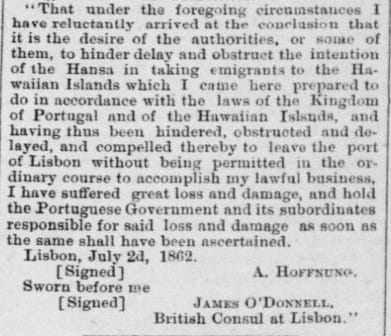
Eventually, local officials gave in. The Hansa set sail from Portugal on July 11th. The rest of the voyage was unremarkable. The ship arrived in Honolulu at the beginning of September.
Once in Hawaii, Anna Jacintha and her children were processed at the Portuguese Consulate in Honolulu. They waited there with the other passengers to find out which plantation would be their new home.
The Pachecos were assigned to the Kilauea Sugar Plantation on Kauai. Once in Kilauea, they were provided housing. They started working soon after.
Although there are no records in Kilauea that give details of Anna Jacintha’s life once she settled in, we know she was there. Tucked away in the Kilauea Catholic Cemetery is a broken tombstone lying next to a cross.
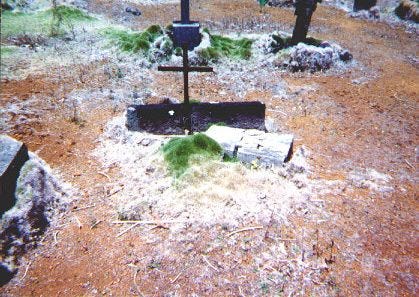
Several years ago, a cemetery survey recorded the name on the stone “Anna Jacintha A. Pacheco”. She died at the age of 67, spending 20 years of her life in Kilauea. Her sons Joao and Jose, as well as numerous descendants, are also buried there.
This article was written for Robin Stewart Genealogy Matters Storyteller Tuesday Challenge: Ancestral Women 2026
Notes:
I have spent a couple of decades searching for proof in multiple villages that Jacintho Pacheco, Anna’s husband, died in the Azores. The last mention of Jacintho is on son Theodoro’s baptismal record in Achada, 1876. I suspect he abandoned them. The story passed down was that Anna Jacintha murdered him. You never know!
Although Anna Jacintha’s passport says she was 52, she was really 47 at the time she applied.
Why were the residents of Lisboa so unhappy?
Either way - a fascinating story. This is an aspect of Hawaiian history with which I'm not familiar, so I loved learning about it.